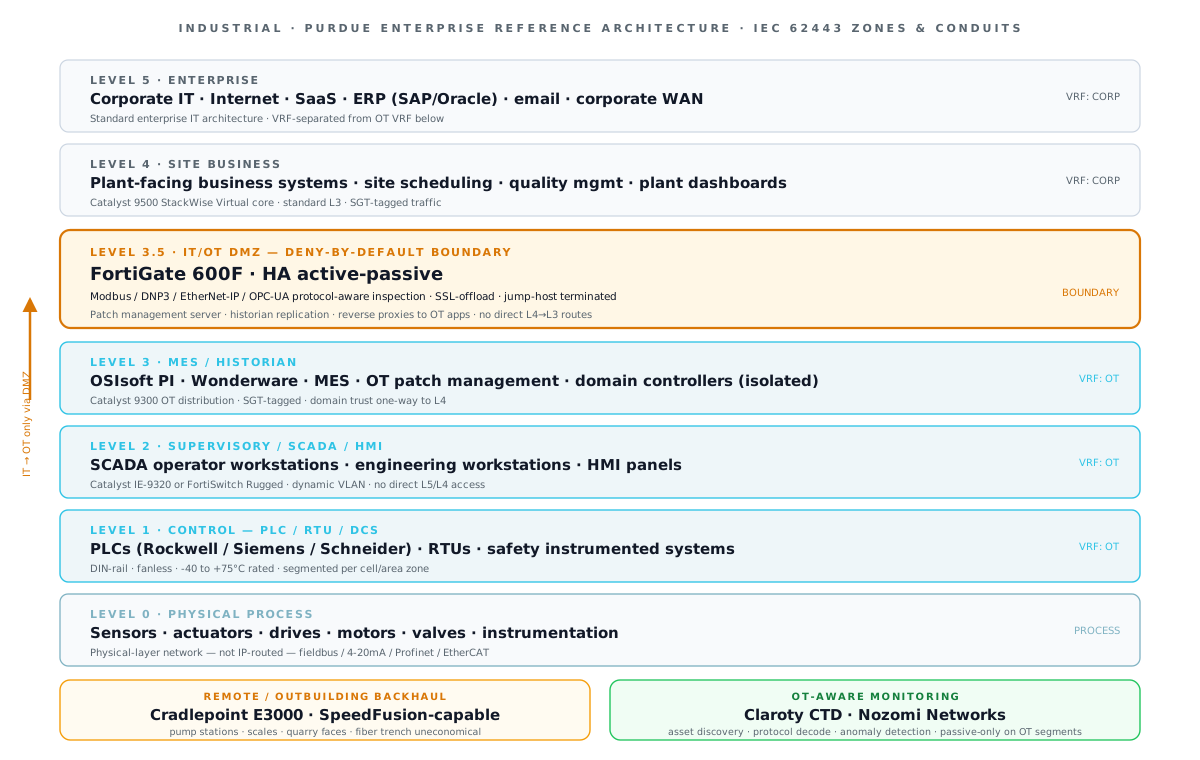
Industrial networks survive heat, vibration, dust, and a protocol mix most IT teams never see. Ruggedized switching, Purdue Model segmentation between OT and IT, and cellular where fiber can't go. Netcom builds it to the IEC 62443 reference — not whatever the IT team happened to have in the closet.
The most common industrial networking failure mode: OT equipment and corporate IT on the same broadcast domain. A misconfigured workstation sends a broadcast storm and a paper mill's control loop goes unresponsive for six minutes. Or a ransomware infection on an accounting laptop reaches the plant-floor HMI because there's no segmentation between Levels 3 and 4.
The Purdue Enterprise Reference Architecture solves this on paper. In practice, most plants never finished the retrofit — the DMZ exists as a diagram but the firewall rule base passes everything, the engineering workstation dual-homes to both sides, and the control-system VLAN spans the whole facility.
Netcom does Purdue the boring way. Real zones. Real conduits. Real firewalls at the IT/OT boundary with deny-by-default rules. Ruggedized Catalyst IE or FortiSwitch Rugged at Levels 1 and 2 so the hardware doesn't die in the summer heat. Cradlepoint or Peplink cellular backhaul for remote buildings where fiber trenching costs more than the entire electrical budget. And documentation that your control engineer, your auditor, and your insurance carrier all accept.
Sized for a mid-sized industrial facility. Scales down for single-site shops and up for multi-plant enterprises with a shared IT/OT DMZ.
Illustrative customers drawn from real deployment patterns. Names are fictional; scope, vendors, and outcomes reflect actual Netcom work.
Flat L2 plant: corporate ERP, CNC controllers, and HMIs all on one broadcast domain. Cyber insurance renewal required Purdue-aligned segmentation. Netcom designed Level 3.5 DMZ with FortiGate 600F HA and re-VLANed the floor onto Catalyst IE-9320. The cultural obstacle: the plant's senior controls engineer had dual-homed his laptop to both OT and IT for a decade. Removing the dual-home extended the schedule by three weeks, required deploying a dedicated RDP jump host, and involved two meetings with the plant manager before the engineer accepted the workflow change. Technical work finished on time; the political work was the long pole.
Cooperative with 8 grain elevators across three states, networking built organically over 20 years. No consistent firmware, no central visibility, rural sites on consumer DSL. Netcom standardized on FortiGate 80F + FortiSwitch + Cradlepoint S700 5G primary where fiber wasn't economical. What broke the first plan: two elevators had metal silos directly between the 5G router and every nearby cell tower, killing signal inside the office. Had to run exterior antennas up 40-foot poles with lightning arrestors; added $6K per site and 4 weeks of coordination with the local electrician. Eight sites live on uniform standard with quarterly firmware cadence.
Quarry operations needed SCADA telemetry from scales, belt conveyors, and pump stations across 5 remote sites with no carrier service on-premise. Netcom engineered dual-path: licensed microwave from each quarry to the nearest tower, Cradlepoint E3000 with panoramic MIMO as cellular fallback, FortiGate termination at corporate. The surprise: one quarry's microwave path was line-of-sight on paper but failed under summer heat haze from the rock surface — atmospheric refraction we hadn't accounted for. Raised the microwave dish on that site by 12 feet on a new mast and the link stabilized. SCADA uptime cleared 99.9% after the retrofit.
Send us your plant layout, your control-system inventory, and your cyber-insurance renewal deadline. Within 10 business days you'll get a Purdue-aligned design, a ruggedized BOM, and a cutover plan sequenced around production windows.