InfrastructureSecurity & Firewall
Pillar 02 · Security

Segmentation-first security. Built for compliance.

Perimeter-only security is obsolete. We design next-gen firewall architectures with layered segmentation, identity-aware policy, and SIEM integration — built for PCI, HIPAA, CMMC, and SOC 2 from day one.

5
NGFW platforms we design on — Fortinet, Cisco Secure, Palo Alto, Meraki, Check Point
4
compliance frameworks designed in — PCI, HIPAA, CMMC, SOC 2
0
implicit-trust zones · every flow is policy-evaluated
Security · Mid-tier
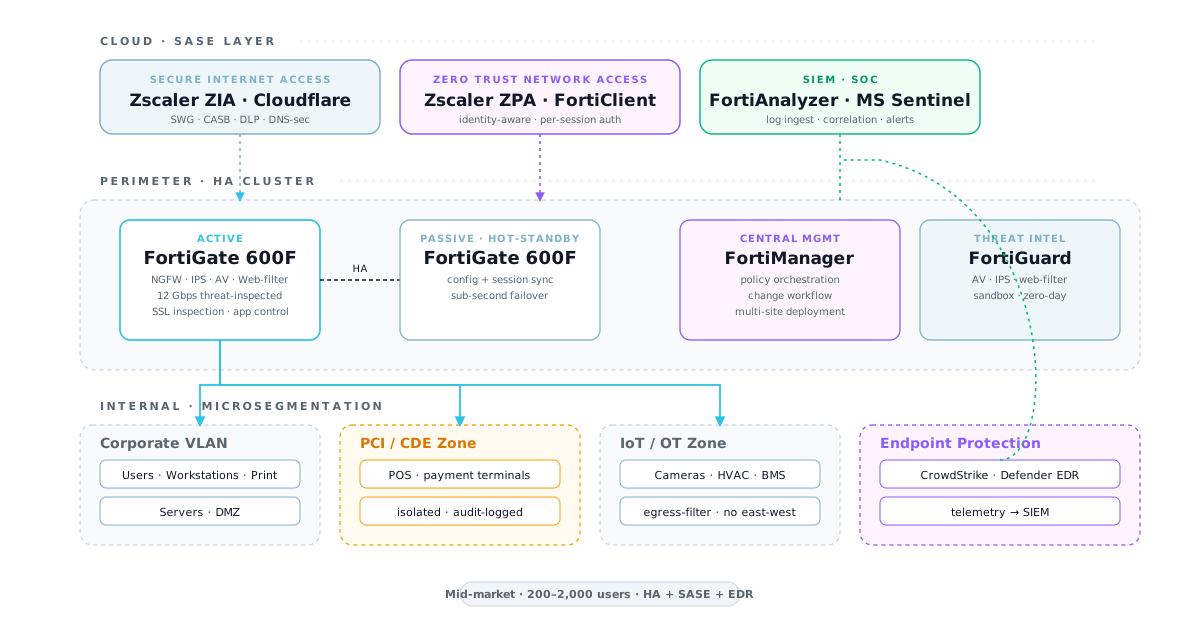
Mid-market Fortinet NGFW HA cluster with SASE, EDR, and SIEM reference architecture
The Problem

Firewalls at the edge are not a security architecture.

A NGFW at the perimeter without internal segmentation is one lateral-movement step from a full compromise. A security architecture that can't produce an audit trail for every flow is one audit finding from a failed PCI attestation. And a ZTNA deployment grafted onto a legacy VPN is worse than either done alone.

We design security as a layered system: NGFW cluster at the perimeter with deep inspection, internal microsegmentation via firewall VLANs or Zero Trust microperimeters, identity-aware access replacing legacy VPN, endpoint detection feeding a SIEM, and cloud-delivered SASE for distributed users.

Platform choice depends on environment: Fortinet when you want firewall + SD-WAN + switching from one vendor with the tightest integration; Cisco Secure or Palo Alto when deep policy sophistication is required at scale; Meraki MX when cloud-managed simplicity wins. We don't have a preferred OEM — we have a preferred outcome.

Three tiers. Real vendor choices. Real BOMs.

Match your scale; adapt to your compliance posture.

Meraki MX + Microsoft Defender + Cisco Umbrella
Cloud-managed NGFW with AMP + IDS/IPS at the edge · DNS-layer threat protection via Umbrella · Defender for Endpoint on every managed device · basic segmentation by VLAN. Right-sized for single-site SMBs without dedicated security staff.
SMB · single-site · 25–150 users

Cloud-managed stack — minimal ops burden

Get threat inspection at the edge, DNS-layer filtering, and endpoint detection without running a SOC. Everything managed through web dashboards; Netcom configures policy and stays available for escalations.

RoleVendor & ModelNotesLicense
Perimeter NGFWCisco Meraki MX85 / MX95NGFW · IDS/IPS · AMP · AutoVPNAdvanced Security
DNS-layer securityCisco Umbrellablock malicious domains before DNS resolvesProfessional / Insights
Endpoint EDRMicrosoft Defender for Endpoint P2included in M365 Business Premium · telemetry centralizedper-seat
Email securityMicrosoft Defender for Office 365phishing · safe links · attachment sandboxingper-seat
Backup / DRVeeam · Datto (vendor-neutral)3-2-1 backup · ransomware recovery planper-endpoint

Which platform for which environment.

Compliance posture, operational maturity, and existing vendor estate drive the recommendation.

Use casePrimaryAlternates
SMB · single site · cloud-managed preferenceMeraki MX + UmbrellaFortiGate 60F + FortiClient
Mid-market · security + SD-WAN unifiedFortinet Secure SD-WAN + FortiGateMeraki MX Advanced Security
PCI scope · point-to-point policyFortinet or Palo AltoCisco Secure Firewall
HIPAA · healthcare · BAA requiredFortinet or Cisco SecureMeraki MX with HIPAA BAA
CMMC Level 2 / 3 · DoD supply chainPalo Alto · Cisco SecureFortinet (with attestation)
Remote / hybrid workforce · VPN replacementZscaler Private AccessCloudflare Access · FortiClient ZTNA
SASE / distributed usersZscaler ZIA+ZPAPalo Alto Prisma Access · Cato · Cloudflare
SIEM · mid-marketMicrosoft SentinelFortiAnalyzer · Splunk Cloud
SIEM · enterpriseSplunk Enterprise SecurityMicrosoft Sentinel · Elastic
Endpoint EDRCrowdStrike FalconMicrosoft Defender for Endpoint · SentinelOne

What Netcom delivers

  • Security architecture design with segmentation map and policy framework
  • NGFW deployment — staging, config, cutover, rule migration from legacy
  • ZTNA rollout with phased VPN decommissioning plan
  • SIEM implementation — log source onboarding, correlation rules, dashboards
  • EDR rollout across managed endpoints with telemetry pipeline to SIEM
  • Compliance attestation support — PCI / HIPAA / CMMC / SOC 2 evidence gathering
  • Quarterly rule cleanup + firewall policy review
  • Optional managed service: 24/7 monitoring via our NOC partner, incident response coordination

Our design process

  • Security posture assessment — interview, current-state audit, gap analysis
  • Compliance framework mapping (PCI / HIPAA / CMMC / SOC 2) with in-scope asset inventory
  • Threat model — what we're defending against, what acceptable risk looks like
  • Segmentation design — VLAN / VRF / microperimeter strategy
  • Policy architecture — default-deny posture, exception documentation, review cadence
  • Platform recommendation with pro/con analysis, peer-reviewed
  • BOM, deployment sequence, cutover plan, rollback criteria
  • Phased rollout — always a reference site first, then pattern-match to rest

Where security architecture earns its keep.

Compliance-heavy verticals where the firewall rule base, the segmentation plan, and the logging chain all have to pass audit — not just work.

Audit your security architecture?

Send us a rough network diagram, your compliance framework, and any outstanding audit findings. In 10 business days you'll get a design memo identifying gaps, recommending a platform, and sequencing the remediation.